Why Callum Foster Decided to Pursue a Career in Health and Fitness
7 minute readBehind every successful career is a story of inspiration, determination and personal growth. For Callum Foster, a career in health and fitness was shaped not only by a passion for helping others but also by personal experiences that left a lasting impression from an early age.
Before establishing himself in a specialist area of the industry, Callum took his first steps towards a fitness career by qualifying as a personal trainer at a young age. Combined with his university studies, these early experiences helped lay the foundations for a career dedicated to improving health and wellbeing.
Years later, that journey would lead to life-changing moments, including helping an individual take steps they never thought possible and supporting people through some of their most significant physical challenges.
In the first part of our learner spotlight series, Callum reflects on the personal experiences that shaped his career, the moment he discovered a passion for inclusive fitness, and why he knew he needed specialist education to take the next step.
In this article, you’ll learn:
- What inspired Callum to pursue a career in health and fitness
- How personal loss shaped his career direction
- The moment that led him into inclusive fitness
- Why he chose to specialise with HFE
Learning What Really Matters
Nobody handed me this. There was no moment where someone in the industry spotted me, backed me and told me I was onto something. For a long time it was just me, coaching in someone’s garden in front of no one in particular, trusting that the work itself was enough. That trust came from somewhere specific. It came from a man who lived his entire life by the same principle, who showed up fully for people regardless of whether anyone was watching or applauding or even paying attention. My grandad taught me that, and once you have really seen someone operate that way, it becomes the only standard worth holding yourself to.
There are things I knew about my grandad and things I didn’t. I didn’t know what he earned, what car he drove or where he sat in any particular hierarchy. None of that ever reached me. What did reach me, what I felt every single time I was around him, was that he believed every person deserved a chance regardless of where they came from, what they looked like or what the world had already decided about them. He made me speak to everyone, not just the people who were easy to speak to or the people who looked and sounded like us, but everyone. Respect and manners were never occasional in his world; they were the baseline, non-negotiable and consistent. He had a way of making people feel genuinely seen that I couldn’t articulate as a child but have spent most of my adult life trying to recreate.
Finding Direction After Loss
I lost him when I was seventeen and, understandably, it affected me. My focus dipped and I found myself more distracted than usual, just a young lad who had lost someone important and was finding it harder to concentrate on the things that were supposed to matter. Everything felt uncertain at that age anyway, and losing him added a layer to that uncertainty that I didn’t quite have the tools to process.
The gym gave me something useful to put my energy into. Movement gave me structure and a sense of forward motion at a time when not much else did. I didn’t analyse it particularly deeply at the time. I just knew that training made me feel better and that the environment suited me.
It was during that uncertain period that I completed my initial personal training qualifications. The gym had already shown me what movement could do for a person and I wanted something purposeful to work toward. What started as a way of channelling my energy gradually revealed itself as something with far more meaning behind it. I just hadn’t found that meaning yet.
Questioning Who Fitness Was Really For
From there I went to university to study Sports Science, which gave academic shape and rigour to what I had begun to feel intuitively through training. Somewhere inside that degree my thinking began to shift in a very specific direction. I kept returning to the same question: what about the people the fitness industry simply wasn’t considering?
What about disabled people, those with learning differences, people who had spent their whole lives receiving the message that sport and movement weren’t really meant for them?
I knew personally what movement had been able to do for me during a difficult period, and the thought that entire communities of people couldn’t easily access that same thing made me want to do something about it. That question began shaping my academic research and I started writing about SEN sporting access and the structural gaps in how fitness was being designed and delivered for people with additional needs.
Why Inclusive Fitness Matters
39.3% of disabled people are physically inactive, compared with 19.7% of non-disabled people, according to Activity Alliance’s Annual Disability and Activity Survey (2025-2026). Despite increased awareness, this gap has remained largely unchanged for almost a decade.
Nearly one-third of disabled children also do less than 30 minutes of physical activity each day, with inactivity levels remaining virtually unchanged for five consecutive years.
Sources: Activity Alliance (2024, 2025).
The Session That Changed Everything
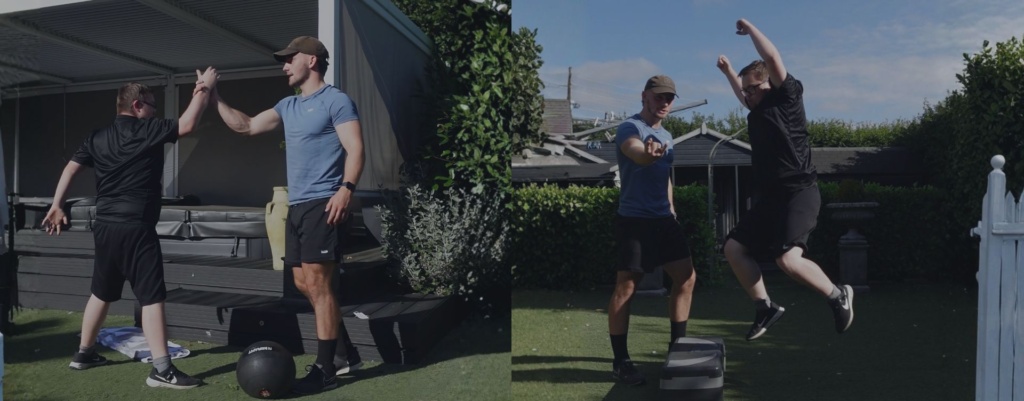
The moment that truly changed the direction of my life didn’t happen in a classroom or a training facility. I was round at a mate’s house one afternoon when I noticed his brother, Ollie Hatcher, who has Down syndrome, outside on his phone by himself. Something pulled at me straight away. I wanted to help him and I wanted to see what he could do. I asked my mate whether he’d mind if I came back the next day and did a bit of training with him. He said yes, so I did.
Twenty minutes in a back garden with a lad I had never coached before, doing something that hadn’t been planned or organised in any formal sense, just two people moving together because it felt like exactly the right thing to do. I remember how that session felt far more clearly than I remember the specific exercises we did.
Ollie was smiling, laughing, fully alive in what he was doing. He just wanted to show me everything he could do, and he did. The way his face lit up, the way he looked at me, he believed in me in that session in the same way my grandad had always believed in me, and that felt incredible. At the end of it he told me he felt like Superman.
I didn’t have the words for what that did to me in that moment. I just knew I had never felt anything quite like it in my professional life.
Discovering My Purpose
Something settled in me in that garden. The years of study, the personal loss, the wanting to prove something to a man who was no longer there to see it, all of it arrived somewhere quiet and certain.
I looked at Ollie and thought: if I can make one person feel like that, what could I do for others like him across my hometown? What could this become if I gave it everything? That question changed everything.
Taking the Next Step
Looking back now, that instinct to stop and notice Ollie, to want to see him shine, that wasn’t simply me acting on a whim. That was everything my grandad had taught me about how to truly see people, finally showing up in practice.
After that session I wanted to do it again, and again after that. Knowing that if I was going to do this properly and give people like Ollie the standard of coaching they deserved, I needed to get genuinely qualified in this specific area. Not a general personal training certificate, but something purposeful, something that would actually equip me for the reality of what I had just experienced.
That is when I found HFE.
Explore the full series:
- Why Callum Foster Decided to Pursue a Career in Health and Fitness
- How Specialist Training Helped Callum Build an Inclusive Coaching Career
- Building One of the UK’s Leading Inclusive Fitness Platforms
Interested in developing the skills Callum needed? Explore HFE’s inclusive fitness courses.
Author
Beth Riley
Writer and Content Creator
Beth is a content creator specialising in health, wellness and education. With an MA in Graphic Design, she brings together strategy, design thinking and storytelling to create engaging content that informs, inspires and connects with audiences.
Subscribe to our newsletter
And get the fast-paced world of personal training delivered straight to your inbox every week
Great news, you're on the list...